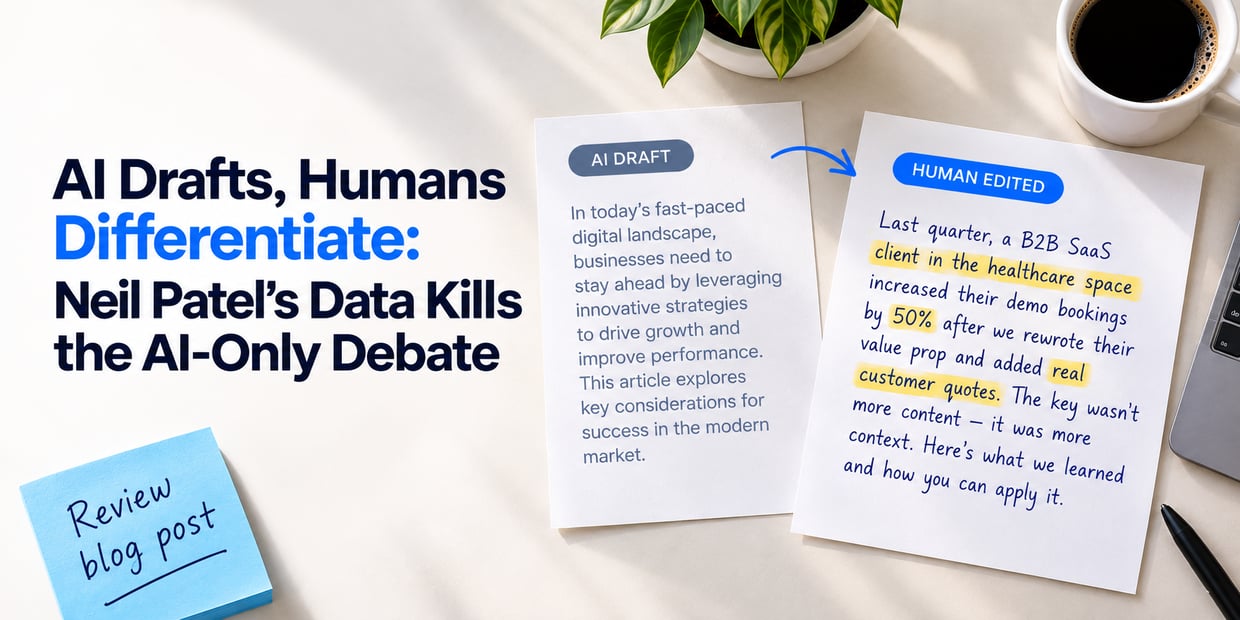
AI Drafts, Humans Differentiate: Neil Patel's Data Kills the AI-Only Debate
TL;DR: We can stop debating AI versus no AI. The real divide is unreviewed, generic AI content versus AI-assisted work with human judgment and proprietary data. Let AI draft but make your marketers make it valuable. Neil Patel's research shows the gap: human-edited AI content drives significantly more traffic than raw AI output. Human-written content outperforming AI-only content by 5.4x over a 12-month period.
Answer-first (AEO)
Publishing raw AI output costs you significantly in traffic compared to a human-edited version. Neil Patel's NP Digital study of 744 articles found human articles averaged 283 visits per post by month five, while AI-only averaged 52 visits. The gap exists because Google rewards human judgment, not AI detection.
Where Most Teams Lose the Thread
Teams are under pressure to produce more with fewer resources. AI looks the perfect answer: an outline in seconds, a first draft in minutes. This used to cost thousands and took weeks. Efficiency is undeniable, but here is where it breaks down.
An AI model is built to generate plausible language from patterns in what already exists. It cannot independently contribute to a conversation you had with a customer last week, a campaign result from your own marketing, a product decision your team made, or a defensible perspective that originated inside your company. When everyone publishes similarly generic AI text, the result is volume, not differentiation. And Google, increasingly, treats undifferentiated AI content as a trust problem, not a feature.
The operational reality: Neil Patel's NP Digital team ran a study of 744 articles across 68 websites, comparing AI-generated content against human-written content over 12 months. Human-written articles outperformed AI-only content in every month measured. By month five, human content averaged 283 visits per post while AI-generated content averaged just 52 visits—a 5.4x performance gap. The gap continued widening over time. Additionally, when Google's September 2024 spam update rolled out, sites with unreviewed AI-only content took a 17% traffic hit and dropped 8 search positions on average. Sites with AI content that had been edited and polished by humans only dropped 6% in traffic and 3 positions in rankings. The evidence is clear: trustworthiness and human judgment are what move rankings and clicks.
The False Choice: AI or No AI
Here is what is actually happening. Every team capable of producing 10 blog posts a month now feels pressure to produce 15. AI makes that possible. The mistake is treating the first draft as the finished asset.
Marketing leaders should frame the choice like this: What gets published has to be better than what competitors publish. That bar does not care whether AI touched the draft. It cares whether the finished piece contains something a competitor cannot replicate: your customer evidence, your proprietary data, your firsthand judgment. That is where the human layer comes in. Not to rewrite for style. To add proof and remove anything generic.
| Approach |
Strength |
Where It Fails |
Best Use |
| No AI / fully human-written |
Original judgment, creative voice, firsthand reporting, brand decisions |
Slower, higher cost for repeatable work |
Flagship thought leadership, executive perspectives, community content |
| AI-only |
Fast outlines, basic explainers, ideation |
Generic claims, stale facts, weak differentiation, no accountability |
Internal drafts and starting points—not finished assets |
| Human + AI |
Faster production while keeping expertise, accuracy, and distinctive value |
Requires intentional editorial step and clear owner |
Most SEO articles, nurture content, landing pages, content refreshes |
How to Add the Human Layer Without Killing Speed
Before an AI-assisted piece goes live, give a qualified editor or subject-matter expert 20 focused minutes. The goal is not cosmetic rewriting. The goal is to add proof and remove interchangeability.
1. Add a specific customer moment or result.
Insert a real example from your work: an anonymized project, a client pattern, a concrete result. "One client saw a 50% lift on their hero CTA after a single copy change" is not interchangeable with "improve your conversion rate." This establishes that the content comes from practitioners, not a web summary.
2. Insert information AI could not know.
Proprietary research, internal benchmarks, a decision framework, post-campaign learnings, product usage data. The question: Could a competing agency reproduce this paragraph with a public prompt? If the answer is yes, the piece needs more of your judgment in it.
3. Cut filler. Make each claim earn its place.
AI drafts often repeat the obvious and hedge unnecessarily. ("In today's fast-paced landscape.") Cut them. Replace vague statements with a practical recommendation, a specific example, or a decision criterion. Readers should leave with an action they can take.
4. Verify facts and refresh the page.
Confirm every statistic, product capability, comparison, and external link. Cite primary sources. Replace dated screenshots. Repair dead links. AI can create polished but incorrect statements. Factual review stays a human responsibility.
5. Put a real, qualified person behind it.
Attach the piece to a named expert with credentials and a real profile. This does not mean that person wrote it from scratch. It means they are willing and able to stand behind the analysis, explain its limits, and update it when conditions change. That accountability is what AI cannot supply.
Different Rules for Search and Social
For SEO, AI can be a productive drafting tool if the final page contains credible expertise, original evidence, and a rigorous edit. The goal is a durable resource that answers a searcher's need better than the competition.
For social media, the bar is different. Audiences engage with a recognizable human perspective: an opinion formed from experience, a behind-the-scenes lesson, an honest reaction, a point of view that feels specific to the creator. AI can brainstorm and edit, but it should not replace the core idea or voice.
A useful shorthand: Edit for search. Create for social.
How to Build This Into Your Operating Model
Build AI into the production workflow, not around the editorial workflow.
Start with a human-owned content brief that defines: audience, business objective, distinctive insight, the proof that will support it, the CTA, and the author. Use AI to accelerate the repetitive work: outlining, research summarization, first-draft production. Then require the human layer before publishing. Make one person accountable for subject-matter validation and the final claim.
Measure what matters. Track organic visibility, qualified traffic, conversions, assisted pipeline, and the time required for revision. If AI makes publishing faster but raises correction costs or produces assets nobody wants to cite or convert on, it is not improving the system. You are just publishing more mediocre.
FAQ
Does using AI for content production hurt your SEO rankings?
Raw, unreviewed AI content gets penalized. AI content strengthened by human editorial judgment ranks as well as human-written content. Google's core update in September 2024 explicitly targeted low-value AI-generated content. The difference is not the tool; it is the edit.
Can a small team use AI without letting it tank content quality?
Yes, if you apply a 20-minute human review before anything ships. One person responsible for factual accuracy, proprietary evidence, and voice consistency. That person becomes the bottleneck—but a human bottleneck is preferable to publishing 10 generic pieces instead of 5 strong ones.
What's the difference between "human-edited AI" and "human-written"?
A: The starting point. If you start with AI and then add human judgment, you might save 30% of production time. If you start with a human brief and use AI as a structural tool, you save more. Either way, the final piece is human-accountable. The shorthand is: AI for production efficiency, humans for trust and differentiation.
Should we give our AI outputs to junior writers, or experienced ones?
Experienced ones. A junior writer will polish the prose. An experienced marketer will question the claims, add evidence, spot what is missing, and rewrite the weak parts. The edit is not about writing quality; it is about judgment.
What should we do with AI content that's already published?
If it is ranking and converting, leave it alone. If it is not, refresh it with one of the five additions above: a customer result, proprietary data, stronger opinion, better specifics, or fact-check with current information.
How do we get AI to produce content that requires less editing?
Feed it real material. Instead of "write about content ROI," feed the prompt: "We saw a 50% lift on this campaign. Explain why human editing makes this possible, cite Neil Patel's research showing human content outperforms AI-only by 5.4x, and anchor it to our retainer model." AI output is only as specific as the input. Vague briefs produce generic drafts.
The Line Between Speed and Trust
AI is excellent at making a draft faster. Marketing professionals are where the value lives: original evidence, customer understanding, sound judgment, a credible voice, and responsibility for the final claim. Never let the AI draft be the final deliverable.
The difference between a piece that ranks, converts, and gets shared—and a piece that vanishes into the noise—is not the AI. It is the 20 minutes of human judgment that comes after the AI finishes.
Your ROI depends on it.
More content than your team can maintain is a cash-flow problem, not a technology problem. At HubBase, we help marketing teams implement the human-led AI workflow in your content and website operations. Our Website Growth Retainer includes ongoing content refresh, competitive analysis, and human-audited SEO improvements—so your existing assets keep working while new content stays trustworthy. Book a Consultation



















.png?width=343&height=334&name=Frame%20(3).png)
.png?width=343&height=479&name=Frame%20(4).png)

 10 min read
.png?width=400&height=260&name=blog_feature_image%20(1).png)



.png?width=204&height=62&name=Frame%20(13).png)
.png?width=204&height=62&name=Frame%20(18).png)
.png?width=204&height=62&name=Frame%20(11).png)
.png?width=204&height=62&name=Frame%20(12).png)
.png?width=204&height=62&name=Frame%20(15).png)
.png?width=204&height=62&name=Frame%20(16).png)
.png?width=204&height=62&name=Frame%20(17).png)
.png?width=194&height=62&name=Frame%20(20).png)
